Why Perfection Weakens Us: The Counterintuitive Power of Chaos
- Danielle Dodoo
- Feb 17, 2025
- 5 min read

Updated: Feb 18, 2025

Perfection is a scam. Trust me, I've been lured in by it's promises of control, efficiency, and mastery for years. It's only now I'm beginning to realise it’s made me fragile.
In artificial intelligence, perfection is deliberately corrupted through regularisation - a process that introduces controlled chaos to create stronger, more adaptable systems.
Turns out, humans need the same thing.
Fast fact: AI systems trained on perfectly clean data often fail in real-world applications. A bit of strategic noise makes them far more effective. The same principle applies to you.
The Perfection Trap
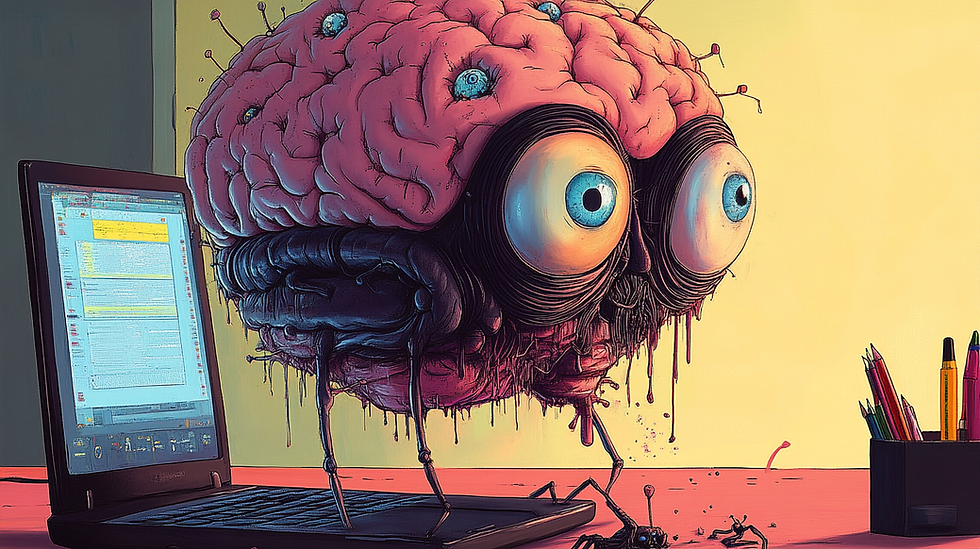
Perfectionism is the human equivalent of AI's technical term: overfitting. This is when an AI model becomes too optimised for a specific dataset and collapses when faced with the unexpected. Sound familiar? Humans do this all the time.
Encouraged by the unhelpful nudges of productivity gurus (thanks, Tim Ferris) and social media, we curate our environments, optimise our routines and filter our digital inputs. Why? We believe that an efficient and error free life equates to value and quality. We believe we’re becoming better.
Perfection isn’t strength; it’s a liability. The more we try to engineer perfect routines, perfect skills, and perfect conditions, the more fragile we become. When the unexpected hits, we break.
This becomes especially relevant in the evolution of our iSelf - the ever-blurring fusion of digital and organic identity. Our digital lives offer precision control. Every variable can be fine-tuned, every experience tailored. But if we become too optimised for the world we expect (or hope for), we may find ourselves incapable of handling the one that actually exists.
The Architecture of Adaptability
In machine learning, regularisation introduces variation during training - forcing AI to adapt. Instead of learning only in pristine conditions, the model is trained in a mix of noise, distortion, and unpredictability. The result? It performs better when conditions change.
Your brain operates on remarkably similar principles. Expose it to controlled chaos, and it learns how to navigate unpredictability with agility. Here’s what happens when you introduce strategic complexity:
Pattern Recognition Sharpens
Rather than memorising exact scenarios, your brain learns to detect underlying patterns, making you adaptable across different contexts.
Neural Plasticity Increases
New and unfamiliar experiences force your brain to rewire, enhancing cognitive flexibility and resilience.
Learning Becomes More Efficient
Slight unpredictability forces deeper engagement, strengthening retention and recall.
Implementing Human Regularisation
In my article "I Call BS on Resilience," I question the obsession we have with "building resilience" and justifying being stretched to breaking point as a badge of honour. The universe fucking with you is not controlled chaos. Making poor decisions is not controlled chaos. Controlled chaos isn’t about random discomfort - it’s about strategic variation. Here’s how to apply it across key areas:
Learning Environments
Change Your Study Spaces: Rotate between a quiet library, a busy café, and an outdoor space. Each environment forces your brain to adapt to new stimuli.
Vary Your Input Methods: If you usually read, listen to a podcast instead. If you learn best through visuals, try summarising concepts verbally.
Introduce Complexity: Learning a new language? Start with crystal-clear audio, then gradually introduce background noise, different accents, and multiple speakers.
A year ago, if you had told me I could edit my book with the TV on, a crying two year old (not mine) next to me and constant interruption, I'd have refuted it whilst having mini panic attacks at the mere thought. But, whilst I wasn't at my most efficient, I learned how to focus with the environment I was given. A little white noise playing in my ears helped.
Neuroscientific studies have shown that neural circuits can generate complex activity patterns, both spontaneously and in response to stimuli. By modifying synaptic strengths within a neural network, chaotic spontaneous activity can be transformed into desired activity patterns, enhancing the brain's adaptability and learning capabilities.
Social Architecture
Expand Your Social Contexts: Engage in three different environments - networking events, deep one-on-one conversations, and completely new social settings.
Challenge Your Communication Style: If you’re direct, practice diplomacy. If you tend to soften your words, experiment with being more concise and assertive.
Diversify Your Relationship Dynamics: Work with, befriend, or mentor people outside your typical social/professional circles. Observe the shifts in your behaviour and adaptability.
Professional Development
Skill Context Shifting: Apply your expertise in different settings. A developer could code in an unfamiliar language, a writer could experiment with different topics and tones, a project manager could take on a role in a completely different industry.
Deliberate Workflow Disruption: Identify your most efficient habits - then alter one variable at a time. Work at different hours, change your input sources, adjust your problem-solving approach.
Controlled Discomfort: If you perform best in solitude, occasionally work in collaborative spaces. If you thrive on structure, deliberately throw in some ambiguity and observe your response. You might feel initial resistance and frustration, but stick with it.
Love or hate Elon Musk, the CEO of SpaceX and Tesla is known for immersing himself in diverse fields - from automotive to aerospace - often venturing into areas where he has no prior expertise. He might have ADHD and might be a bit nuts, but this deliberate exposure to varied challenges is the foundation of innovative thinking and adaptability.
Richard Branson is also known for frequently stepping out of his comfort zone, engaging in adventurous activities and launching businesses in unfamiliar industries.
Physical Training
Change Your Movement Patterns: If you run, switch between trails, city streets, and indoor tracks. Each terrain forces micro-adjustments in balance, stability, and endurance.
Manipulate Training Conditions: Adjust temperature (safely), time of day, or equipment. If you always train with music, try silence.
Rotate Recovery Methods: Cycle through active recovery, cold therapy, and mobility work. See what optimises long-term performance.
The Regularisation Rate: How Much Chaos is Enough?
Too much chaos, and you break. Too little, and you become rigid. The key is calibration.
Start small. Introduce controlled variability. Monitor your adaptation curve. Increase complexity methodically. The goal isn’t to manufacture hardship - it’s to prevent stagnation.
The Elegant Paradox: Control Through Chaos
By strategically relinquishing control, you gain a deeper mastery over your adaptability. Like an immune system strengthening through exposure, your cognitive and psychological resilience develops when you engage with calculated disruption. And we can become more creative as a result.
The modern and digital world demands this skill. Uncertainty is no longer the exception - it’s the default. We are living through turbulence. Those who thrive won’t be the ones who can create perfect conditions, but those who can navigate imperfect ones.
By embedding regularisation into your iSelf evolution, you don’t just survive chaos - you leverage it for growth.


Love this. Especially linking to your previous article.